


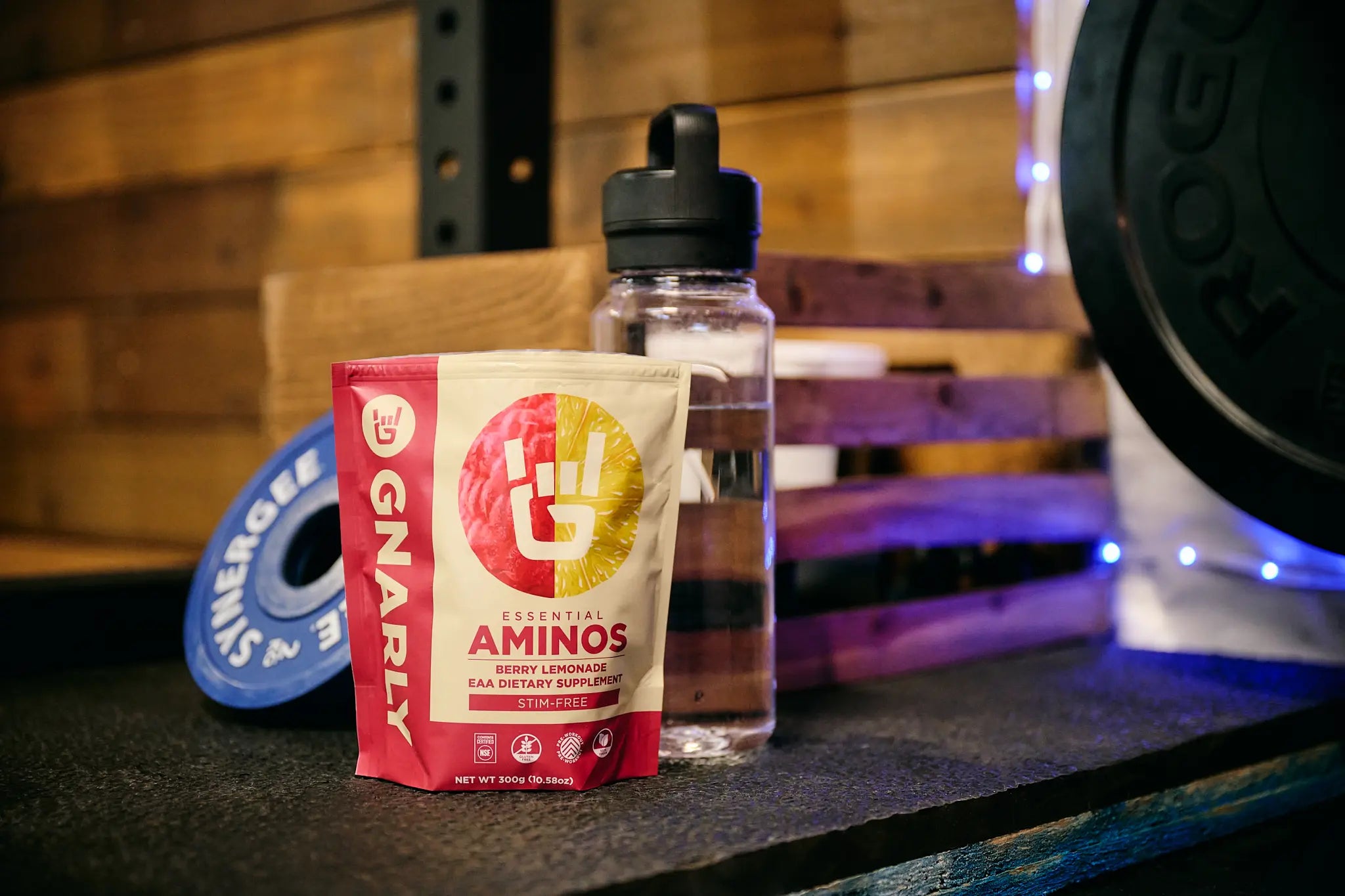
With all the buzz about increasing your protein intake, essential amino acids (EAAs) are having a moment—and for good reason.
Current research suggests that EAA supplementation is one of the most effective nutritional strategies for stimulating muscle protein synthesis (MPS), preserving lean mass, and improving functional outcomes (Bifari, 2017). But what does that actually mean for you—and do you even need them? Let’s break it down.
What Are EAAs (And What Happened to BCAAs)?
There are 20 total amino acids that make up protein. Nine of them are “essential,” meaning your body can’t make them—you have to get them from food.
Branched-chain amino acids (BCAAs)—leucine, isoleucine, and valine—are three of those nine. Leucine, in particular, plays a major role in turning on muscle protein synthesis.
But here’s the key: Leucine may flip the “on” switch, but without the other six essential amino acids, the muscle-building process can’t continue for long. Research shows that while leucine or BCAAs can create a short spike in MPS, sustained muscle building requires all nine EAAs (and really, all 20 amino acids) working together (Plotkin, 2021). Much like how you can’t build a house with just one tool—you need the whole toolbox.
What the Research Shows
After decades of mechanistic and clinical data, it has been shown that EAA supplementation can:
-
Rapidly increase blood amino acid levels
-
Stimulate muscle protein synthesis in a dose-dependent manner (Volpi, 2003)
-
Work synergistically with exercise (Tipton, 1999)
-
Are safe within typical supplemental ranges (Cynober, 2016)
Even small doses (1.5–3g) can stimulate muscle protein synthesis, with maximal stimulation occurring around 15–18g per serving (Wilkinson, 2018).
Unlike whole proteins, EAA supplementation requires no digestion. They’re absorbed quickly, creating a rapid rise in circulating amino acids—a key driver of muscle protein synthesis. And importantly, it’s been shown that taking EAAs doesn’t blunt the anabolic response to later meals (Paddon-Jones, 2005). This means that if you consume EAAs between meals or before training, your muscles can still fully respond to the protein in your next meal.
Why Not Just Eat Whole Foods?
Here at Gnarly, we’re big believers in food-first nutrition. Whole foods provide not just protein, but vitamins, minerals, fiber, and phytonutrients that supplements can’t fully replicate. At their core, EAAs are simply the building blocks already found in protein-rich foods. In a perfect world, you could meet all your needs through whole foods. And for many people, that works.
But the reality is that hitting optimal protein targets (around 1.6–2.2g/kg/day for muscle growth) isn’t always easy—especially if:
-
You’re a weight-class athlete
-
You have a low appetite
-
You’re busy and under-eating
-
You’re plant-based
-
You’re dieting
-
You’re over 65
-
You’re using appetite-suppressing medications
That’s where EAAs can become a strategic tool.
Who Benefits Most from EAAs?
1. Adults Over 65
As we age, our muscles become less responsive to protein intake—a phenomenon called anabolic resistance (Fry, 2011). This means that older adults often require a higher amino acid proportions to maximally stimulate MPS.
Long-term EAA supplementation has been shown to increase lean body mass, strength, and walking speed in older adults—even without formal resistance training (Azhar, 2021).
Preserving muscle isn’t just about aesthetics. It’s about balance, independence, metabolic health, and longevity.
2. Individuals in a Calorie Deficit
When caloric intake decreases, your body’s essential amino acid requirements actually increase (Gwin, 2021). If those needs aren’t met, the body may break down muscle tissue to supply missing EAAs.
That’s why muscle loss often accompanies aggressive dieting.
Supplementing EAAs during a calorie deficit can help preserve lean mass while keeping calories low—making them especially useful for:
-
Physique competitors
-
Weight-class athletes
-
Anyone trying to lose fat without sacrificing muscle
3. Individuals Using GLP-1 Medications
GLP-1 receptor agonists significantly reduce appetite. While effective for weight loss, reduced food intake can make it difficult to consume enough protein.
When total calories—and protein—drop too low, lean muscle mass can decline alongside fat mass.
Because EAAs are low in calories, rapidly absorbed, and easy to consume, they provide essential building blocks to help preserve muscle during medically supported weight loss.
4. Plant-Based Athletes
Plant proteins often contain lower concentrations of certain essential amino acids compared to animal proteins. While it’s absolutely possible to meet needs on a plant-based diet, it often requires higher total intake and careful planning.
EAAs provide a simple way to ensure all nine essential amino acids are present in sufficient amounts to stimulate muscle protein synthesis.
5. Fasted or Early Morning Trainers
Resistance exercise increases both muscle protein synthesis and breakdown. Without amino acids available, net muscle balance may remain negative.
Research shows that combining EAAs with resistance training significantly improves net muscle protein balance and taking EAAs before exercise may even enhance the anabolic response (Tipton, 1999). They’re especially helpful if you haven’t consumed at least 20g of protein within the two hours before training.
6. Injury, Immobilization, or High Stress Periods
EAAs have demonstrated benefits in situations such as:
-
Bed rest and immobilization (Holloway, 2019)
-
Stroke recovery (Aquilani, 2015)
-
Sarcopenia (Aquilani, 2015)
-
Heart failure and metabolic conditions (Aquilani, 2015)
In these cases, rapid absorption and full-spectrum essential amino acid availability help overcome anabolic resistance and support recovery.
How to Use EAAs
EAAs can be taken:
-
Before training (especially if fasted)
-
During long sessions
-
Between meals
-
During calorie restriction
-
During periods of low appetite
Effective doses generally range from 3–15g, depending on your goal. They’re not a replacement for whole food protein—but they are a precise tool when protein intake, appetite, or recovery demands fall short. We still recommend a protein and carbohydrate meal after training.
The science is clear: full-spectrum essential amino acids are more than just a trend.
EAA supplementation is a strong stimulator of muscle protein synthesis, synergistic with exercise, and particularly valuable in aging, calorie deficits, and recovery settings.
Whole foods should always be your foundation. But when life, training demands, injury, or medications make optimal protein intake difficult, EAAs can help bridge the gap—so you preserve more muscle, recover more effectively, and perform at your best.
References:
Aquilani, R., Emilio, B., Dossena, M., Baiardi, P., Testa, A., Boschi, F., Viglio, S., Iadarola, P., Pasini, E., & Verri, M. (2015). Correlation of deglutition in subacute ischemic stroke patients with peripheral blood adaptive immunity: Essential amino acid improvement. International journal of immunopathology and pharmacology, 28(4), 576–583. https://doi.org/10.1177/0394632015608249
Azhar, G., Wei, J. Y., Schutzler, S. E., Coker, K., Gibson, R. V., Kirby, M. F., Ferrando, A. A., & Wolfe, R. R. (2021). Daily Consumption of a Specially Formulated Essential Amino Acid-Based Dietary Supplement Improves Physical Performance in Older Adults With Low Physical Functioning. The journals of gerontology. Series A, Biological sciences and medical sciences, 76(7), 1184–1191. https://doi.org/10.1093/gerona/glab019
Bifari, F., Ruocco, C., Decimo, I., Fumagalli, G., Valerio, A., & Nisoli, E. (2017). Amino acid supplements and metabolic health: a potential interplay between intestinal microbiota and systems control. Genes & nutrition, 12, 27. https://doi.org/10.1186/s12263-017-0582-2
Cynober, L., Bier, D. M., Kadowaki, M., Morris, S. M., Jr, Elango, R., & Smriga, M. (2016). Proposals for Upper Limits of Safe Intake for Arginine and Tryptophan in Young Adults and an Upper Limit of Safe Intake for Leucine in the Elderly. The Journal of nutrition, 146(12), 2652S–2654S. https://doi.org/10.3945/jn.115.228478
Fry, C. S., Drummond, M. J., Glynn, E. L., Dickinson, J. M., Gundermann, D. M., Timmerman, K. L., Walker, D. K., Dhanani, S., Volpi, E., & Rasmussen, B. B. (2011). Aging impairs contraction-induced human skeletal muscle mTORC1 signaling and protein synthesis. Skeletal muscle, 1(1), 11. https://doi.org/10.1186/2044-5040-1-11
Gwin, J. A., Church, D. D., Hatch-McChesney, A., Howard, E. E., Carrigan, C. T., Murphy, N. E., Wilson, M. A., Margolis, L. M., Carbone, J. W., Wolfe, R. R., Ferrando, A. A., & Pasiakos, S. M. (2021). Effects of high versus standard essential amino acid intakes on whole-body protein turnover and mixed muscle protein synthesis during energy deficit: A randomized, crossover study. Clinical nutrition (Edinburgh, Scotland), 40(3), 767–777. https://doi.org/10.1016/j.clnu.2020.07.019
Holloway, T. M., McGlory, C., McKellar, S., Morgan, A., Hamill, M., Afeyan, R., Comb, W., Confer, S., Zhao, P., Hinton, M., Kubassova, O., Chakravarthy, M. V., & Phillips, S. M. (2019). A Novel Amino Acid Composition Ameliorates Short-Term Muscle Disuse Atrophy in Healthy Young Men. Frontiers in nutrition, 6, 105. https://doi.org/10.3389/fnut.2019.00105
Paddon-Jones, D., Sheffield-Moore, M., Aarsland, A., Wolfe, R. R., & Ferrando, A. A. (2005). Exogenous amino acids stimulate human muscle anabolism without interfering with the response to mixed meal ingestion. American journal of physiology. Endocrinology and metabolism, 288(4), E761–E767. https://doi.org/10.1152/ajpendo.00291.2004
Plotkin, D. L., Delcastillo, K., Van Every, D. W., Tipton, K. D., Aragon, A. A., & Schoenfeld, B. J. (2021). Isolated Leucine and Branched-Chain Amino Acid Supplementation for Enhancing Muscular Strength and Hypertrophy: A Narrative Review. International journal of sport nutrition and exercise metabolism, 31(3), 292–301. https://doi.org/10.1123/ijsnem.2020-0356
Tipton, K. D., Ferrando, A. A., Phillips, S. M., Doyle, D., Jr, & Wolfe, R. R. (1999). Postexercise net protein synthesis in human muscle from orally administered amino acids. The American journal of physiology, 276(4), E628–E634. https://doi.org/10.1152/ajpendo.1999.276.4.E628
Volpi, E., Kobayashi, H., Sheffield-Moore, M., Mittendorfer, B., & Wolfe, R. R. (2003). Essential amino acids are primarily responsible for the amino acid stimulation of muscle protein anabolism in healthy elderly adults. The American journal of clinical nutrition, 78(2), 250–258. https://doi.org/10.1093/ajcn/78.2.250
Wilkinson, D. J., Bukhari, S. S. I., Phillips, B. E., Limb, M. C., Cegielski, J., Brook, M. S., Rankin, D., Mitchell, W. K., Kobayashi, H., Williams, J. P., Lund, J., Greenhaff, P. L., Smith, K., & Atherton, P. J. (2018). Effects of leucine-enriched essential amino acid and whey protein bolus dosing upon skeletal muscle protein synthesis at rest and after exercise in older women. Clinical nutrition (Edinburgh, Scotland), 37(6 Pt A), 2011–2021. https://doi.org/10.1016/j.clnu.2017.09.008


